What Dry Actually Means
The floor looks dry two days in. The equipment stays for five more. Here's what the readings are actually checking before anyone calls a job finished.
September 15, 2026 · 3 min read
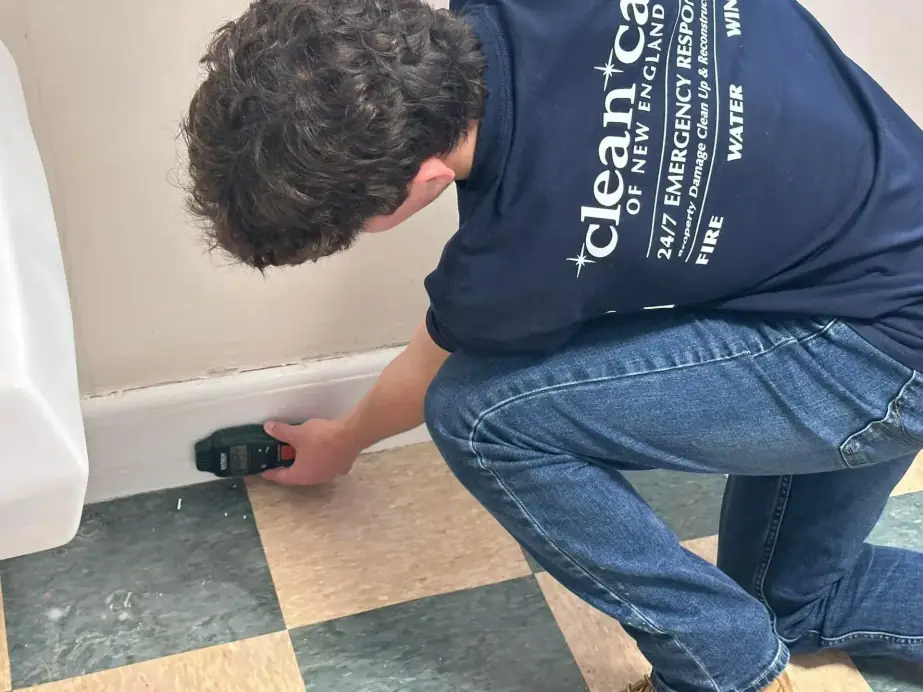
Two days after a water loss, the floor looks dry, the carpet feels dry underfoot, and it's natural to wonder why the fans and dehumidifiers are still running. The honest answer is that what a floor looks like and what a floor actually is are two different questions, and only one of them can be answered by walking across it in socks.
Looks dry and is dry are different things
Surface moisture evaporates fast. That's exactly what makes it unreliable as a signal that a structure is actually dry. Water that soaked into a subfloor, into the bottom few inches of a drywall panel, or into the wood framing behind a baseboard can sit there for days after the surface feels fine to the touch, and it keeps doing damage the entire time, warping wood, feeding mold growth, weakening drywall from the inside. The only way to know the difference is to measure it, not guess at it.
Moisture mapping: where the readings actually come from
A moisture meter reads the actual water content inside a material, not just whether the surface feels wet. A technician works the affected area room by room, wall by wall, taking readings at set points and marking them against a baseline reading taken from an unaffected, dry part of the same house. That baseline matters, a wood floor in a Rhode Island basement in February reads differently than the same floor in August, so the comparison has to be against this house, this week, not a textbook number.
Wall cavities and subfloor: the parts nobody can see
The places that take longest to dry are almost never the visible ones. Water wicks up inside a wall cavity well above the visible water line on the drywall, sometimes twelve or eighteen inches higher than where the stain stops. Subfloor under a carpet or under tile holds moisture long after the surface above it reads dry, because the flooring material on top of it slows the airflow that would otherwise pull the moisture out. This is why a drying job sometimes involves cutting small inspection holes or pulling a baseboard, not to cause more damage, but to confirm what's actually happening inside the wall instead of guessing from outside it.
The air in the room gets tracked too, not just the materials in it. Relative humidity and temperature readings, taken alongside the moisture readings, tell a technician whether the dehumidifiers are actually pulling moisture out of the space fast enough or whether the setup needs adjusting, more air movers, a repositioned dehumidifier, a door left open or closed. A room can have dry feeling air and a soaked subfloor at the same time, which is exactly why both get measured rather than just one.
Why the equipment stays after the floor looks fine
Air movers and dehumidifiers aren't there to dry the surface, the surface dries on its own within a day or two regardless. They're running to pull moisture out of the structure itself, the subfloor, the framing, the insulation, and that takes measurably longer. Pulling the equipment early because the floor looks and feels dry is one of the most common ways a water job turns into a mold job three weeks later. The equipment comes out when the readings say the structure is dry, not when the room looks presentable again.
Daily readings, and why the adjuster wants them too
Readings get taken and logged daily for as long as the equipment runs, at the same points each time, so there's a clear record of the structure drying over days, not just a single reading at the start and a verbal assurance at the end. That daily log does double duty. It tells the crew exactly when the job is actually finished instead of when it looks finished, and it's precisely the kind of documentation an insurance adjuster wants to see attached to a claim, dated, specific, and showing the moisture level actually coming down over time rather than a one line note saying the area is dry.
Dry isn't a feeling or a guess. It's a number, taken at the same spot on different days, that eventually matches the baseline reading from the rest of the house. Everything about how long the equipment stays comes back to that.
Clean Care of New England, (401) 941-9111
Call (401) 941-9111More articles
The First Hour After a Burst Pipe or a Flooded Basement
Before a truck ever pulls up, what happens in that first hour decides how bad the damage really gets.
Why Mold Keeps Coming Back, and What Actually Stops It
Bleach makes mold disappear for a few weeks. Here's why it comes back, and what actually has to change for it to stay gone.